



Semiconductor Chiller Complete Guide
In advanced semiconductor manufacturing, Semiconductor Chiller systems are critical for maintaining stable process conditions, ensuring wafer quality, and improving production yield. As chip geometries continue to shrink, thermal control accuracy becomes one of the most important factors in fabrication success.
For semiconductor fabs, equipment integrators, and OEM suppliers, selecting a high-performance Semiconductor Chiller is essential for achieving stable process cooling and ultra-precise temperature control systems.
Why Semiconductor Manufacturing Needs Cooling Systems
Modern semiconductor processes generate significant heat during operation. Without precise cooling, even slight temperature fluctuations can affect wafer uniformity and device performance.
Key reasons include:
Maintaining stable lithography conditions
Ensuring consistent etching results
Preventing thermal drift in deposition systems
Protecting sensitive wafer structures
In advanced fabs, wafer cooling system design directly impacts yield rate and process repeatability.
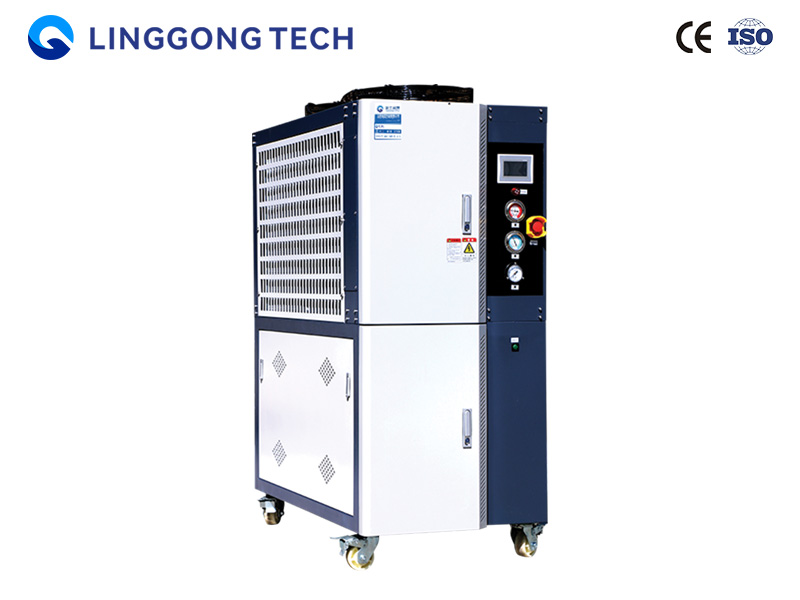
Air-Cooled Integrated Refrigeration Chiller
What Is a Semiconductor Chiller?
A Semiconductor Chiller is a high-precision thermal management system designed to deliver stable cooling fluid at tightly controlled temperatures for semiconductor equipment.
It is widely used as a chiller unit for semiconductor equipment, supporting critical processes such as:
Etching systems
CVD (Chemical Vapor Deposition)
PVD (Physical Vapor Deposition)
Lithography systems
These systems require continuous precision temperature control to maintain process stability.
Semiconductor Chiller Working Principle
A Semiconductor Chiller operates through a closed-loop refrigeration cycle:
Refrigerant absorbs heat from process fluid
Compressor increases refrigerant pressure
Condenser releases heat to environment
Expansion valve regulates flow
Chilled fluid returns to equipment loop
This cycle ensures continuous and stable process cooling for semiconductor tools.
Temperature Control Accuracy: Why It Matters
One of the most critical performance metrics is temperature stability.
Typical accuracy levels include:
±0.1°C standard precision systems
±0.01°C ultra-precision systems
High-end semiconductor fabs require precision temperature control at ±0.01°C to avoid wafer distortion and ensure consistent thin-film deposition.
Even small fluctuations can affect:
Film thickness uniformity
Lithography alignment accuracy
Etch rate consistency
Key Applications in Semiconductor Manufacturing
Etching Systems
Maintains stable plasma conditions and prevents process drift.
CVD Systems
Ensures uniform chemical reaction temperature across wafers.
PVD Systems
Controls deposition stability for thin-film layers.
Lithography Equipment
Supports ultra-precise temperature environments for pattern accuracy.
Each application relies heavily on stable Semiconductor Chiller performance.
Industrial-Grade vs High-Precision Semiconductor Chiller
Industrial-Grade Chiller
Temperature stability: ±0.5°C to ±0.2°C
Suitable for auxiliary cooling
Lower cost and simpler design
Used in non-critical equipment
High-Precision Semiconductor Chiller
Temperature stability: ±0.1°C to ±0.01°C
Advanced PID control systems
High-performance sensors
Designed for core semiconductor tools
High-end fabs strongly prefer ultra-stable systems for production consistency.
Key Selection Criteria for Semiconductor Chillers
When selecting a Semiconductor Chiller, engineers typically evaluate:
Flow Rate Capacity
Must match tool cooling demand to avoid thermal lag.
Temperature Range
Typical operating ranges: 5°C–30°C depending on process requirements.
Stability Performance
The most critical factor in precision temperature control systems.
Heat Load Handling
Must support dynamic thermal loads from semiconductor tools.
System Reliability
Continuous 24/7 operation is required in fabs.
Integration Compatibility
Compatibility with wafer cooling system and fab automation networks.
Global Semiconductor Industry Demand Trends
The global semiconductor industry is rapidly expanding due to:
AI chip production growth
Advanced node manufacturing (3nm, 2nm)
High-performance computing demand
Automotive semiconductor expansion
As process nodes shrink, demand for ultra-stable Semiconductor Chiller systems continues to rise.
Key trends include:
Higher demand for ±0.01°C systems
Increased adoption of smart cooling control
Integration with fab-wide IoT monitoring
Energy-efficient cooling system design
Why LINGGONG Semiconductor Chillers?
LINGGONG specializes in advanced thermal management solutions for semiconductor manufacturing environments.
LINGGONG Semiconductor Chiller systems are designed with:
Ultra-stable temperature control algorithms
High-precision sensors for real-time feedback
Advanced refrigeration architecture
Stable long-term continuous operation
Compatibility with semiconductor production tools
These features ensure reliable performance in critical process cooling environments.
FAQ
1. What is a Semiconductor Chiller used for?
A Semiconductor Chiller is used to provide stable and precise cooling for semiconductor manufacturing equipment such as etching, CVD, PVD, and lithography systems.
2. Why is temperature control so important in semiconductor manufacturing?
Because even minor fluctuations in precision temperature control can affect wafer quality, film uniformity, and chip yield.
3. What is the difference between ±0.1°C and ±0.01°C systems?
±0.01°C systems provide ultra-high stability required for advanced nodes, while ±0.1°C systems are used in less sensitive processes.
4. Which equipment uses Semiconductor Chillers most?
Common applications include wafer processing tools, deposition systems, etching machines, and lithography equipment.
5. Can Semiconductor Chillers be integrated into factory automation systems?
Yes, modern systems support digital monitoring and integration with fab-wide control networks.
Contact Us
LINGGONG is committed to delivering high-precision thermal control solutions for next-generation semiconductor manufacturing systems.
For technical consultation, specifications, or quotation requests regarding Semiconductor Chiller, please contact us:
Email: global@linggongtech.com
 Previous: None


