



Air-Cooled vs Water-Cooled Semiconductor Chillers: Which Is Better?
In modern Semiconductor Manufacturing, maintaining precise temperature control is no longer optional—it is essential. As chip designs become more advanced and process tolerances become tighter, even minor temperature fluctuations can affect product quality, production efficiency, and equipment reliability. This is why selecting the right Semiconductor Chiller has become a critical purchasing decision for semiconductor manufacturers worldwide.
One of the most frequently asked questions among engineers, facility managers, and procurement teams is: Should you choose an Air-Cooled Semiconductor Chiller or a Water-Cooled Semiconductor Chiller?
The answer depends on your production requirements, facility infrastructure, operating budget, and long-term expansion plans. Understanding the strengths and limitations of each solution can help buyers maximize return on investment while ensuring stable production performance.
Why Does Temperature Control Matter in Semiconductor Manufacturing?
Every stage of semiconductor production relies on stable thermal conditions. Whether during Wafer Fabrication, Lithography, Etching, Deposition, or Semiconductor Testing, temperature variations can lead to process instability and reduced product yield.
Without a reliable Temperature Control System, manufacturers may encounter:
Increased wafer defects
Lower process consistency
Equipment overheating
Reduced production yield
Higher maintenance costs
Unexpected production downtime
A high-performance Semiconductor Chiller ensures accurate thermal management, allowing critical equipment to operate within optimal temperature ranges.
This is especially important in advanced semiconductor applications where precision is measured in nanometers rather than millimeters.
What Is an Air-Cooled Semiconductor Chiller?
An Air-Cooled Semiconductor Chiller removes heat through ambient air using condenser coils and high-efficiency fans. Because the system does not require a cooling tower or condenser water loop, installation is typically simpler and faster.
Air-cooled systems are widely used in medium-sized manufacturing facilities, electronics production plants, research laboratories, and semiconductor testing environments.
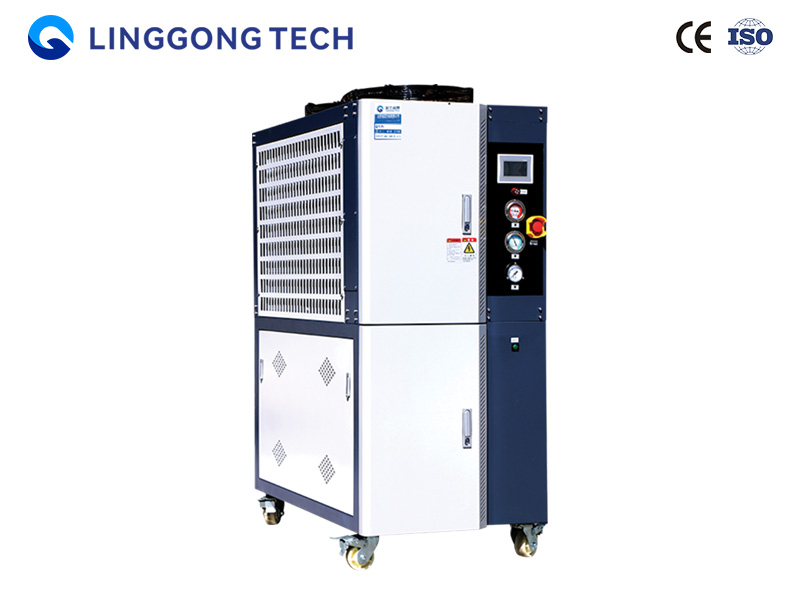
Lingfeng (LF) Air-Cooled Integrated Refrigeration Chiller
Key Advantages of Air-Cooled Semiconductor Chillers
Lower Initial Investment
One of the biggest advantages of an air-cooled system is reduced installation cost. Since no cooling tower or water treatment equipment is required, infrastructure expenses remain relatively low.
Simple Installation and Deployment
Facilities can often install and commission air-cooled chillers more quickly compared to water-cooled alternatives.
Reduced Water Consumption
As sustainability becomes a growing priority, many manufacturers prefer air-cooled solutions because they eliminate continuous water usage.
Easier Maintenance
With fewer auxiliary components, maintenance requirements are generally simpler and less labor-intensive.
Potential Limitations
Air-cooled systems depend on ambient air temperatures. During extremely hot weather conditions, cooling efficiency may decrease. For facilities operating around the clock with heavy thermal loads, electricity consumption may also be higher than water-cooled alternatives.
What Is a Water-Cooled Semiconductor Chiller?
A Water-Cooled Semiconductor Chiller uses circulating water to transfer heat away from the refrigeration system. Heat is then discharged through a cooling tower.
Because water transfers heat more efficiently than air, these systems are commonly found in large-scale Wafer Fabrication Plants and high-volume chip manufacturing facilities.
Key Advantages of Water-Cooled Semiconductor Chillers
Superior Energy Efficiency
Water-cooled systems generally achieve higher efficiency levels, particularly in facilities with continuous production operations.
Excellent Temperature Stability
For semiconductor processes requiring highly accurate thermal control, water-cooled chillers can provide exceptional cooling consistency.
Lower Long-Term Operating Costs
Although installation costs are higher, improved efficiency often leads to lower energy expenses over the lifespan of the equipment.
Scalability for Future Expansion
Large semiconductor manufacturers often choose water-cooled systems because they can accommodate increasing cooling loads as production capacity grows.
Potential Limitations
Water-cooled chillers require additional infrastructure, including:
Cooling towers
Water circulation pumps
Water treatment systems
Extended piping networks
These components increase both installation complexity and maintenance requirements.
Air-Cooled vs Water-Cooled Semiconductor Chillers: Which Is Better?
Which System Has Lower Upfront Costs?
If minimizing capital investment is a priority, the Air-Cooled Semiconductor Chiller is usually the preferred option. The simplified infrastructure significantly reduces installation expenses.
Which Offers Better Energy Efficiency?
For large-scale manufacturing facilities, Water-Cooled Semiconductor Chillers generally provide better energy performance because water is a more efficient heat-transfer medium than air.
Which Delivers Better Temperature Precision?
Both systems can achieve high levels of precision. However, under heavy production loads, water-cooled systems often provide greater thermal stability and process consistency.
Which Is Easier to Maintain?
Air-cooled chillers typically require less maintenance because they do not rely on cooling towers or water treatment equipment.
Which Is Better for Semiconductor Fabs?
For large semiconductor fabrication facilities operating 24 hours a day, water-cooled systems are often considered the long-term solution due to their efficiency and scalability.
Why More Semiconductor Manufacturers Choose LINGGONG
As semiconductor production technology continues to evolve, manufacturers need cooling systems capable of supporting increasingly demanding processes.
LINGGONG has developed advanced Semiconductor Chiller solutions specifically designed for semiconductor applications. These systems provide highly accurate temperature control and reliable operation for mission-critical manufacturing environments.
High-Precision Temperature Control
LINGGONG chillers are engineered to maintain stable temperatures, helping reduce thermal fluctuations that can affect wafer quality and process consistency.
Enhanced Equipment Protection
Effective cooling minimizes the risk of overheating, extending the lifespan of valuable semiconductor equipment.
Improved Production Yield
Consistent thermal management helps manufacturers reduce process variation, resulting in higher product quality and improved yield rates.
Energy-Efficient Performance
Advanced control technology enables LINGGONG systems to optimize cooling performance while minimizing energy consumption.
Reliable Continuous Operation
Semiconductor production often operates around the clock. LINGGONG chillers are designed for long-term reliability in demanding industrial environments.
How to Choose the Right Semiconductor Chiller?
When evaluating a Semiconductor Chiller, buyers should consider several factors:
Required cooling capacity
Temperature accuracy requirements
Facility infrastructure
Available installation space
Energy consumption targets
Future production expansion plans
Maintenance capabilities
A careful assessment of these factors ensures the selected system aligns with both current operational needs and future business objectives.
Final Thoughts
The debate between Air-Cooled Semiconductor Chillers and Water-Cooled Semiconductor Chillers does not have a one-size-fits-all answer.
If your priority is lower installation costs, simplified maintenance, and water conservation, an air-cooled solution may be the ideal choice.
If your facility requires maximum efficiency, superior temperature stability, and long-term scalability, a water-cooled system will often deliver greater value.
Regardless of the configuration selected, investing in a high-quality Semiconductor Chiller is essential for maintaining production stability, protecting equipment, and improving manufacturing performance. With advanced temperature control technology and industry-focused engineering expertise, LINGGONG provides reliable cooling solutions that help semiconductor manufacturers achieve higher efficiency, better yield rates, and sustainable long-term growth.


